Institute for Agroecology – How can we create opportunities for sustainable agriculture through new distribution channels?
How can we create opportunities for sustainable agriculture through new distribution channels? What is sustainability? How can it be measured? How can it be enhanced? How can systems and our behavior be changed in the first place? These are the questions we address at the Institute for Agroecology (IfA).
The Institute for Agroecology (IfA) is a non-profit, scientific advisory institute. Founded in 2020 and headquartered in Aarau, it currently employs 10 people. Our goal is to make a significant contribution to real and effective sustainability for agriculture and the food industry, ecology, animal welfare, biodiversity, and healthy nutrition. Truthfulness in both natural and social sciences is central to our mission: we do not follow dogmas or ideologies, but rely instead on objective, verifiable facts. We have our hands in the soil because we are part of the agricultural sector ourselves. This also means that we always think "from farm to fork" and strive to incorporate the entire food system into our search for solutions and our work. This includes, for example, the resource-efficient use of grassland and animal welfare...
What Pasture-Raised Beef Has to Do with Milk
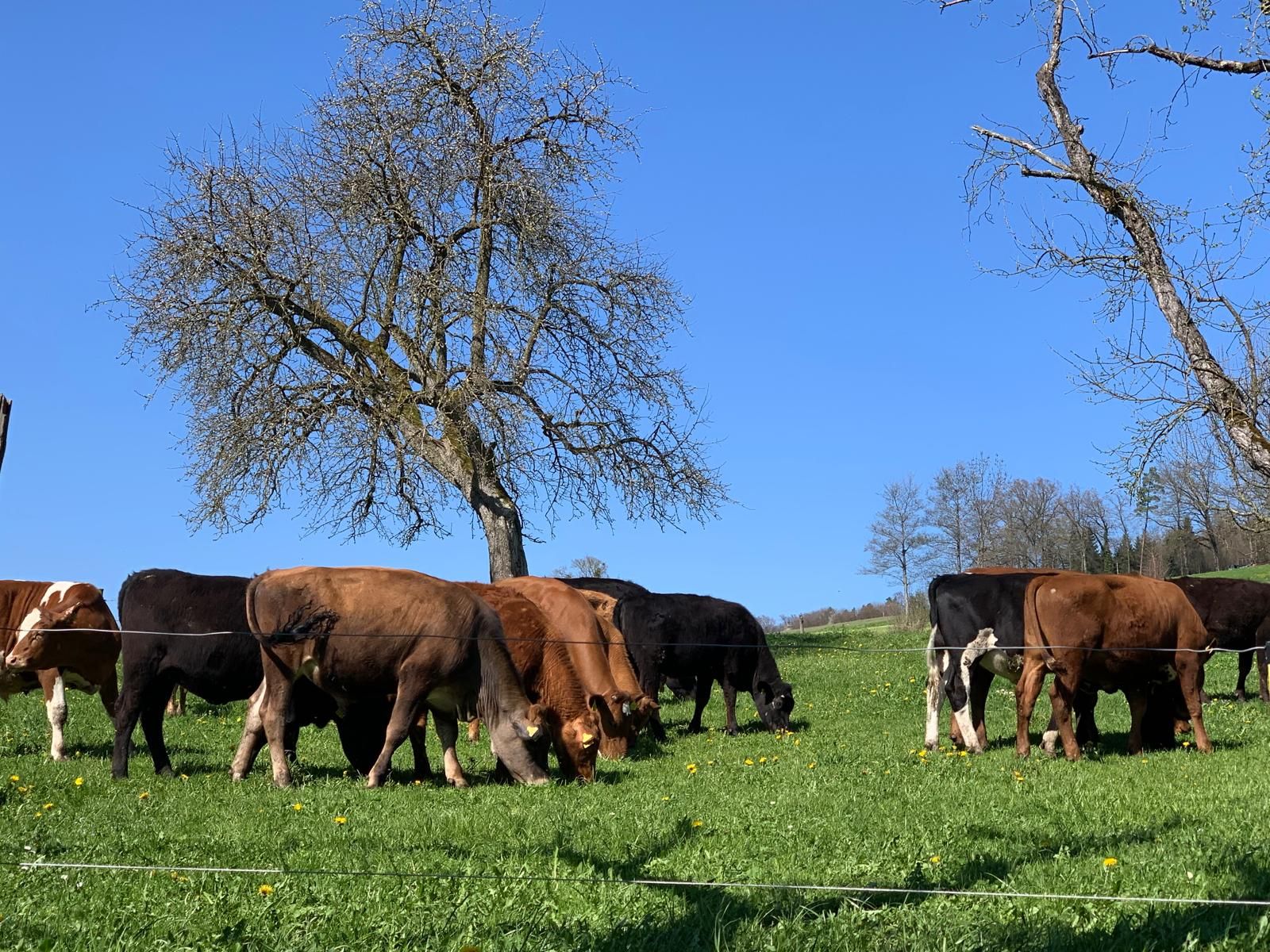
A concrete example of how the food system can be thought of as a whole can be seen in pasture-raised beef. Most calves from dairy farming enter conventional calf and cattle fattening systems as so-called "Tränker" (young unweaned calves), meaning they leave their birth farm after just a few weeks. According to statistics from the Federal Food Safety and Veterinary Office (FSVO / BLV), these calves require the highest use of antibiotics in the entire livestock sector. This indicates a severe systemic flaw. Through our commitment to pasture-raised beef, we promote the synergy between grassland-based dairy and meat production. The benefits of this system are multi-faceted: grassland stores a large amount of carbon in the soil, playing an important role in climate protection. Since the system requires almost no concentrated feed and instead utilizes grassland that is unsuitable for arable farming, arable land remains available for the direct production of human food, entirely in line with the "Feed no Food" principle. Land requirements decrease, which benefits global biodiversity. In addition, the system directly contributes to regional biodiversity, as pasture-based cattle farming ensures the sustainable use of grasslands and summer pastures. The calves stay longer on their birth farm, allowing their immune systems to fully develop before moving to another farm. This strengthens their health, reduces the use of antibiotics, and thereby improves animal welfare.
To systemically improve the animal welfare and health of calves and cattle in Switzerland through the "Swiss Pasture-Raised Beef" system, we intend to launch a new initiative: "Dairy Cattle and Pasture-Raised Beef". Through agricultural consultancy from rearing to (on-farm) slaughter, the development of educational materials, and raising awareness within the industry, we want to anchor and scale this ecologically and socially outstanding form of livestock farming and grassland utilization. We know that education and consultancy are essential, as is setting a new course within the food system. However, market opportunities are also required.
Currently, the market share of pasture-raised beef is only 1-2%. Through our project activities, we are therefore connecting producers and processors to create new sales channels. Following initial pilot projects in Central Switzerland and Bern that demonstrated successful collaboration with catering businesses, this regional approach is now being expanded.
But what about the customers? What happens to new sales channels if consumers don't buy, or don't buy enough? The market share of organic products has stagnated at 12.3% for several years, and many other highly dedicated marketing attempts have had to be abandoned. The customer is king; we cannot force them to buy what we want to produce. Unfortunately, consumption and dietary habits are not sustainable, and ecology plays a subordinate role compared to other factors (e.g., price) in most purchasing decisions. Does the story therefore end at the restaurant table? At the point of sale in the shop? Or is there more to it, more than food…
More Than Food: New Approaches for Consumers
With the initiative "More Than Food" (Mehr als Essen), integrated into the Solothurn resource project Agroecology Switzerland, we are addressing exactly this issue. We are not content with simply accepting that consumption habits are the way they are; instead, we want to create new avenues for nutritional education and behavioral change (through agroecology). Agroecology is the (re)connection of consumers with agriculture. This allows new networks to emerge and new target groups to be reached (see, for example, the "Feldfreunde" in Liechtenstein). Through experiential knowledge and by working together, understanding grows and new habits can be formed. In this project, we are exploring whether and how people can find their way to a more sustainable, balanced daily diet without feeling a sense of deprivation, but rather with greater awareness. Starting in June 2026, consumers will be able to participate in agriculture and other measures via the "Taste the Future" platform. But a word of caution: the project will be scientifically monitored and its success measured. In this way, we aim to learn how this path works while also developing a guideline that shows how success can be achieved.
How Should This Systemic, Science-Based Approach of the IfA Be Categorized?
The "Dairy Cattle and Pasture-Raised Beef" initiative is planned in collaboration with the Haldimann Foundation. "More Than Food" is being implemented in synergy with the Agroecology Switzerland resource project. We look forward to exchanging ideas with all organizations that are driven by similar questions, and we welcome diverse collaborations. An overview of our ongoing non-profit projects can be found here: Link
Further Information: