Swiss NPOs, take note: Copalana Pulse makes feedback easy
Interview with Paul Ryatt – CEO and Co-Founder of Copalana – about Copalana Pulse for non-profit organizations.
1. Let’s briefly go back to the beginning. What triggered the development of Copalana?
The inspiration behind Copalana began with a volunteering experience.
I participated in a volunteering assignment at Credit Suisse, which gave me direct insight into how employee engagement functioned within a large organization. What stood out was not a lack of motivation — employees genuinely wanted to contribute — but the complexity of coordination behind the scenes.
With my background in building scalable digital platforms, I recognized that many CSR activities relied on manual processes, email exchanges, and fragmented reporting. There was clear potential to simplify and professionalize this through digital support.
This led to the development of an initial prototype and, shortly afterwards, to a partnership with Credit Suisse.
The first capability we launched was a fundraising and employee giving module. It was introduced in collaboration with Credit Suisse and used across Switzerland, Europe, and the United States. This enabled the bank to run transparent employee giving campaigns with consistent processes and reliable reporting.
At the same time, Credit Suisse operated a global skills volunteering program — much of which was managed manually. Applications, project matching, approvals, and reporting required considerable administrative effort.
We expanded the platform to support their global skills volunteering needs, introducing clearer project definitions, defined application flows, and improved visibility into participation.
Over time — particularly in Switzerland — we realized that skills volunteering is usually not where the employee journey begins.
For most companies, hands-on, team-based volunteering is the natural starting point. It is accessible, visible, and straightforward to implement. It builds engagement and strengthens company culture. Skills volunteering typically follows later, once organizations have developed more mature CSR programs.
A key milestone in this evolution was our collaboration with Migros Bank. Together, we developed and expanded their volunteering program across Switzerland and have been running their Volunteer Days program since 2022.
The result of this collaboration is a hands-on volunteering marketplace tailored to Switzerland. Small companies can easily find and book individual events, while medium and larger organizations run Volunteer Week campaigns with multiple activities that employees can explore and register for in one place.
2. With Pulse, you have developed your own feedback and analytics tool. What led to that?
Pulse emerged from a recurring observation.
Most organizations can track numbers — volunteers, hours contributed, funds raised. However, these figures do not reflect the actual experience.
Nonprofit partners frequently asked:
- How did volunteers experience the event?
- Would they participate again?
- What could we improve?
Companies were asking similar questions internally.
We realized that something was missing — a simple way to capture participant experience consistently and make it visible to both sides.
Pulse was developed to close that gap and make feedback a natural part of the engagement process.
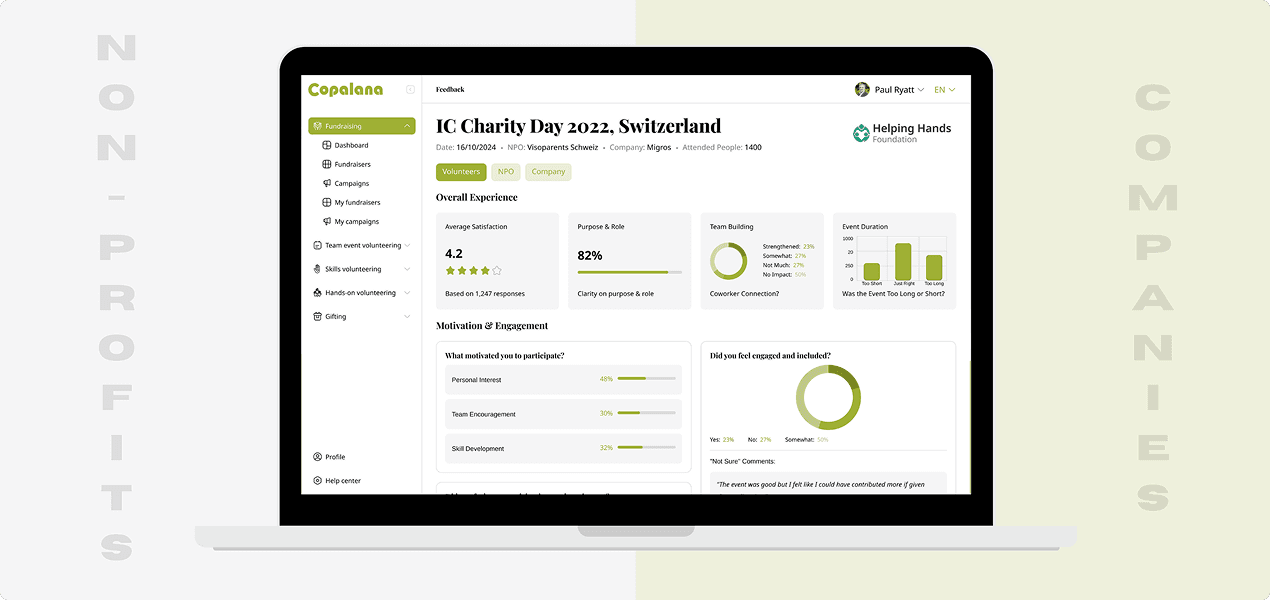
In 2025, we piloted Pulse with two companies. The results were extremely encouraging. For the first time, both nonprofit and corporate partners could see volunteer feedback integrated directly into their respective dashboards — alongside participation data and engagement metrics.
It was exciting to see how experience quality became visible in real time, and how quickly organizations began using those insights to refine event preparation and collaboration.
The pilot confirmed that connecting participation data with participant experience creates tangible value for both sides.
3. How does Pulse work, and how does it differ from traditional survey tools?
Pulse is integrated directly into the volunteering workflow.
After an event, participants receive a short feedback prompt. They evaluate aspects such as:
- Overall satisfaction
- Clarity of purpose and role
- Team-building effect
- Whether they felt engaged and included
- Whether their participation made a meaningful impact
- How well the event supported the nonprofit’s goals
- Likelihood of participating again
They can also share open comments — including highlights, challenges, and suggestions.
Unlike traditional surveys, Pulse is directly linked to a specific activity and automatically aggregates results. There are no external tools, no manual data consolidation, and no lengthy questionnaires.
The result is comparable insight that can be reviewed over time and directly linked to actual engagement.
4. How do Swiss NPOs benefit concretely from Pulse?
For Swiss nonprofits, the main benefit is transparency and ongoing improvement.
Instead of relying on informal impressions, organizations receive aggregated feedback that shows:
- How volunteers perceived the experience
- Whether expectations were communicated effectively
- Whether participants felt their contribution had real impact
- Whether the activity strengthened connection and teamwork
- Whether volunteers would return
Importantly, this feedback is shared with both the company and the nonprofit. It creates a common understanding of what worked well and where adjustments may be useful.
Another important aspect is that nonprofits can initiate Pulse surveys for all of their volunteer activities — not only for events organized through Copalana. This allows them to apply the same feedback approach across different corporate partners and independent engagement formats.
Over time, this generates comparable data. Nonprofits can identify patterns, refine preparation, and demonstrate measurable development across events.
For Swiss NPOs, this strengthens credibility. It supports discussions with corporate partners, boards, and foundations, and reinforces a reputation for professionalism and continuous learning.
5. Does Pulse help strengthen long-term engagement?
Yes — because it links experience with future collaboration.
Volunteer ratings are aggregated and visible internally within the company. CSR teams consider these insights when selecting organizations and event formats for future engagement.
This does not create public rankings. Rather, it enables thoughtful decision-making based on employee experience.
During the 2025 pilot, we saw how quickly companies began using the integrated dashboard insights to identify which events generated the strongest engagement and team-building effects. This directly influenced future planning and strengthened ongoing partnerships.
When volunteers consistently report:
- Clear guidance
- Strong alignment with the nonprofit’s mission
- A genuine sense of contribution
- Positive team-building outcomes
those partnerships tend to deepen naturally.
At the same time, nonprofits receive the same feedback. If participants highlight areas for improvement — such as unclear briefings or logistical challenges — these can be addressed early.
Small adjustments often lead to noticeably stronger experiences.
Over time, this creates a positive cycle:
Improved preparation → stronger engagement → higher satisfaction → repeat participation → more stable partnerships.
Pulse therefore not only measures engagement — it actively supports sustained collaboration.
6. What advice would you give nonprofits who want to better understand and communicate their impact?
I would recommend three things: collect feedback, engage your partners — and keep it simple.
Start by gathering feedback consistently. It does not need to be complex. A few well-chosen questions after each volunteering activity can already provide valuable insight:
- Did participants understand the purpose of the activity?
- Did they feel their contribution mattered?
- Would they engage again?
- Would they recommend your event to other volunteers
Second, actively engage your corporate partners in reviewing the feedback. Transparency builds trust. When both sides openly reflect on what worked well and what could improve, collaboration becomes stronger.
And finally, keep it simple. Impact measurement does not have to be complicated to be meaningful. Consistency matters more than complexity.
In Switzerland, reliability and credibility are key. When nonprofits can demonstrate not only participation numbers but also thoughtful reflection on participant experience, it strengthens long-term partnerships and supports sustainable engagement.